
MPB Meets: Environmental Photographer Nick Brandt
Published March 17, 2025 by MPB
Photographer and activist Nick Brandt’s The Day May Break, photographed in Zimbabwe and Kenya in late 2020, and in Bolivia in March 2022, tells the story of environmental and ecological issues facing people and animals alike. Nick creates an emotionally charged series of portraits that paints the impact of degradation and destruction around the world. In this interview, we hear from Nick about the series, his equipment and experiences.
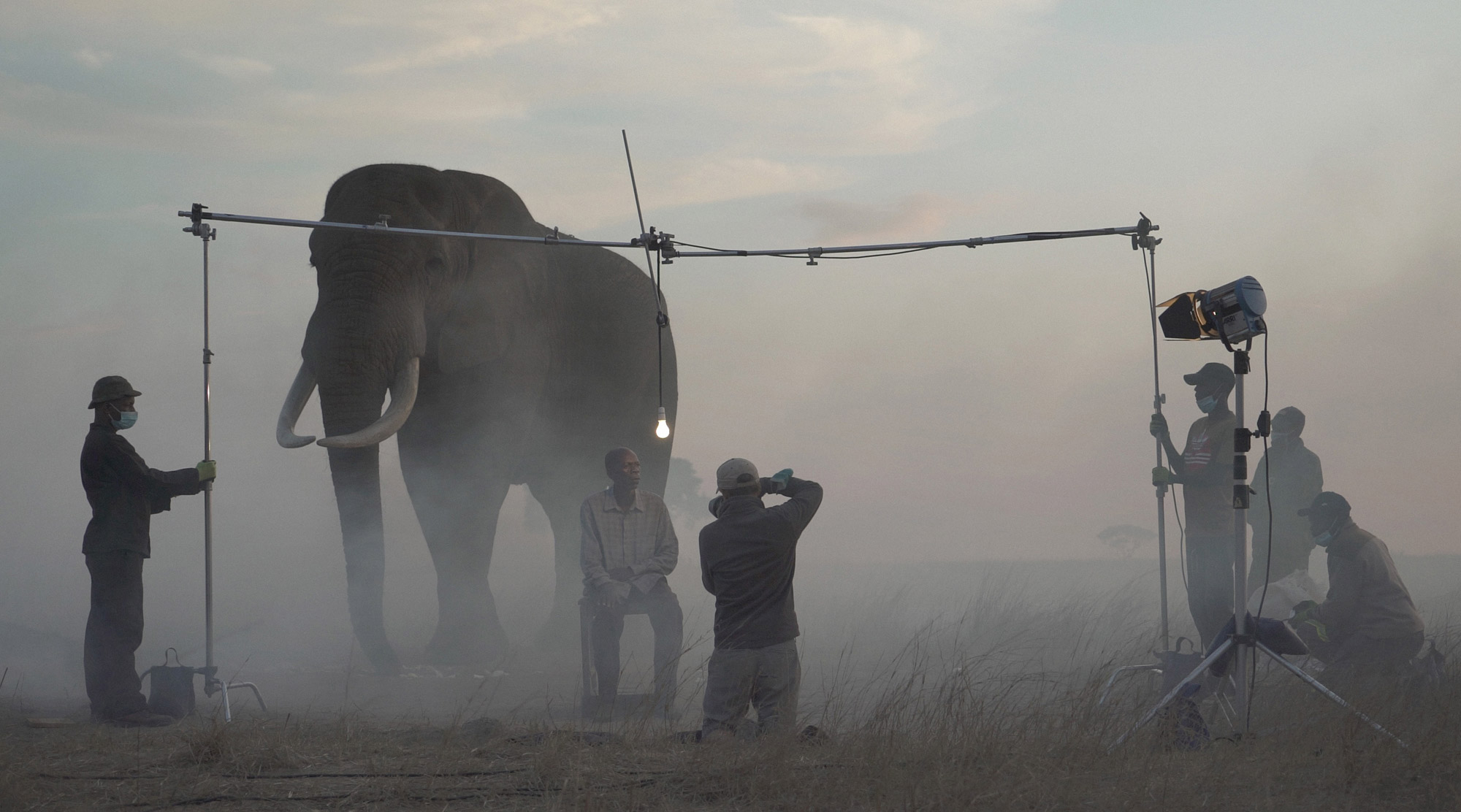
Making of The Day May Break by Nick Brandt, Courtesy of Willas Contemporary
MPB: The Day May Break captures both animals and people in the same frame, showing us perhaps the biggest crisis of all time: the fate of the natural world and humanity impacted by environmental degradation and destruction. Tell us a little more about the process behind each shot.
NB: With the escalation of destruction, the once-recognizable natural world is now fading rapidly from view. The fog in the photographs is symbolic of that. The fog, of course, is also an echo of the smoke from wildfires, driven by climate breakdown devastating so much of the planet. The fog was created on location by fog machines. The photographs were taken at sanctuaries and conservancies, where the animals are almost all long-term rescues, victims of everything from the poaching of their parents to habitat destruction, poisoning and illegal wildlife tracking.
The people in the photos have all been badly affected by climate change— some displaced by cyclones that destroyed their homes, others such as farmers displaced and impoverished by severe years-long droughts. These animals can never be released back into the wild. As a result, they are habituated, and so it was safe for human strangers to be close to them, photographed together in the same frame. In some instances, the animals were very cooperative and trusting of their carers, so they walked onto the desired spot and stayed still long enough to get the photos. For others, they were only still for a fragment of a second for me to get their portrait.

James and Fatu, Kenya 2020, by Nick Brandt, Courtesy of Willas Contemporary
MPB: How was the process of shooting such a large project during the pandemic?
NB: I photographed ‘chapter one’ in Kenya and Zimbabwe between October and December 2020. Normally, the sanctuaries and conservancies where I photographed would have been very busy with tourists and visitors. But at this point of the pandemic, pre-vaccines, all of them were more or less empty, which meant that I had exclusive use of the places for days at a time. It would have been almost impossible to shoot there in normal times, or even now.
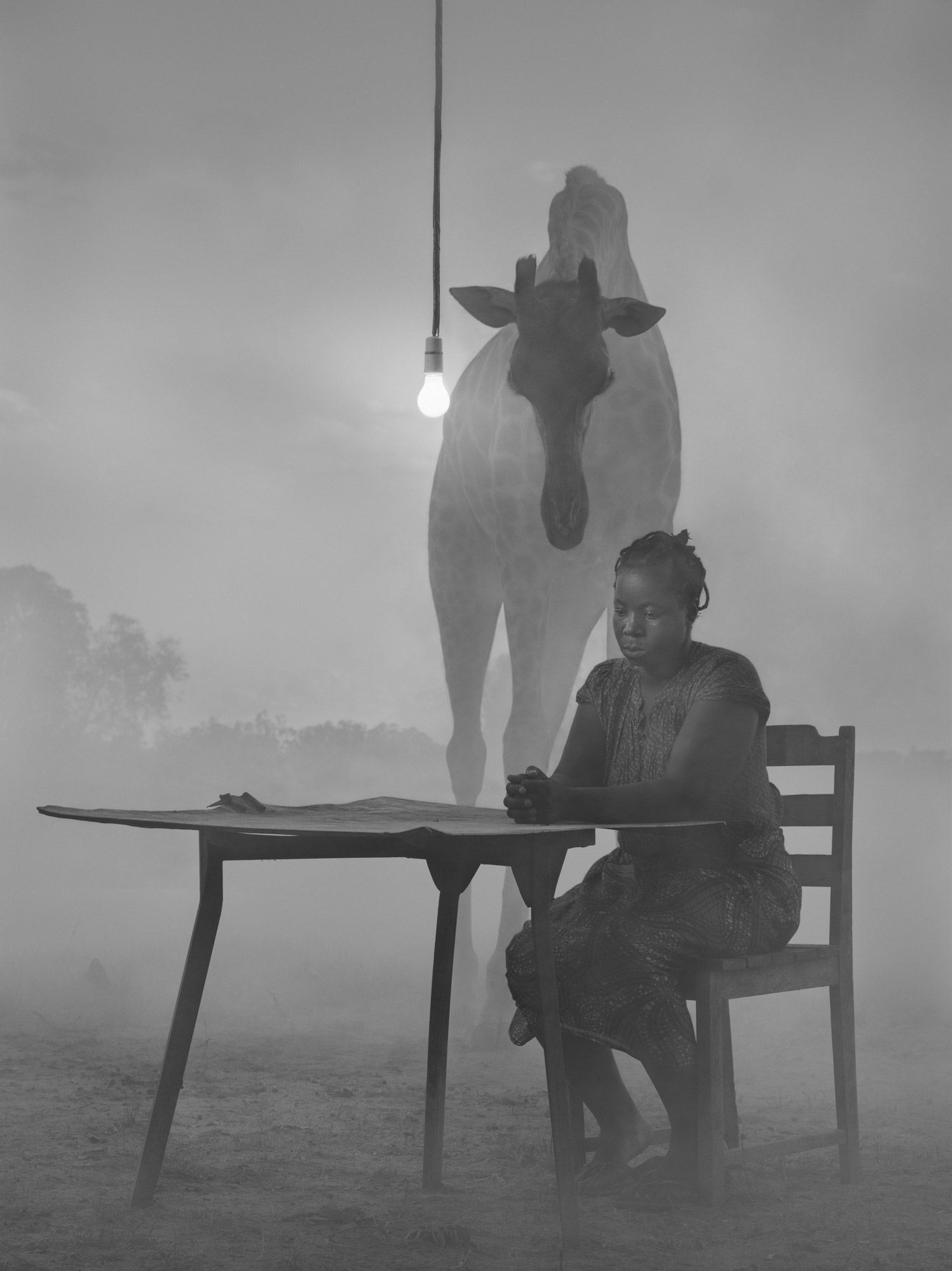
Kuda and Sky II, Zimbabwe 2020 by Nick Brandt, Courtesy of Willas Contemporary
MPB: John Tagg wrote in his essays on photographs and histories that “The most important thing is that the photographs possess an evidential force, and its testimony bears not on the object but on time.” You have been actively confronting and documenting man’s intrusions on the natural landscape for nearly two decades. What do you hope people take away from your photography?
NB: In The Day May Break, both humans and animals are all living on the same very small finite planet, and both humans and animals are connected in our suffering from the destruction of the natural world. The title of each photograph is the names of the subjects, both person and animal, my point is that I want the viewer to think of everyone—human and animal—as individual sentient beings on an equal footing.
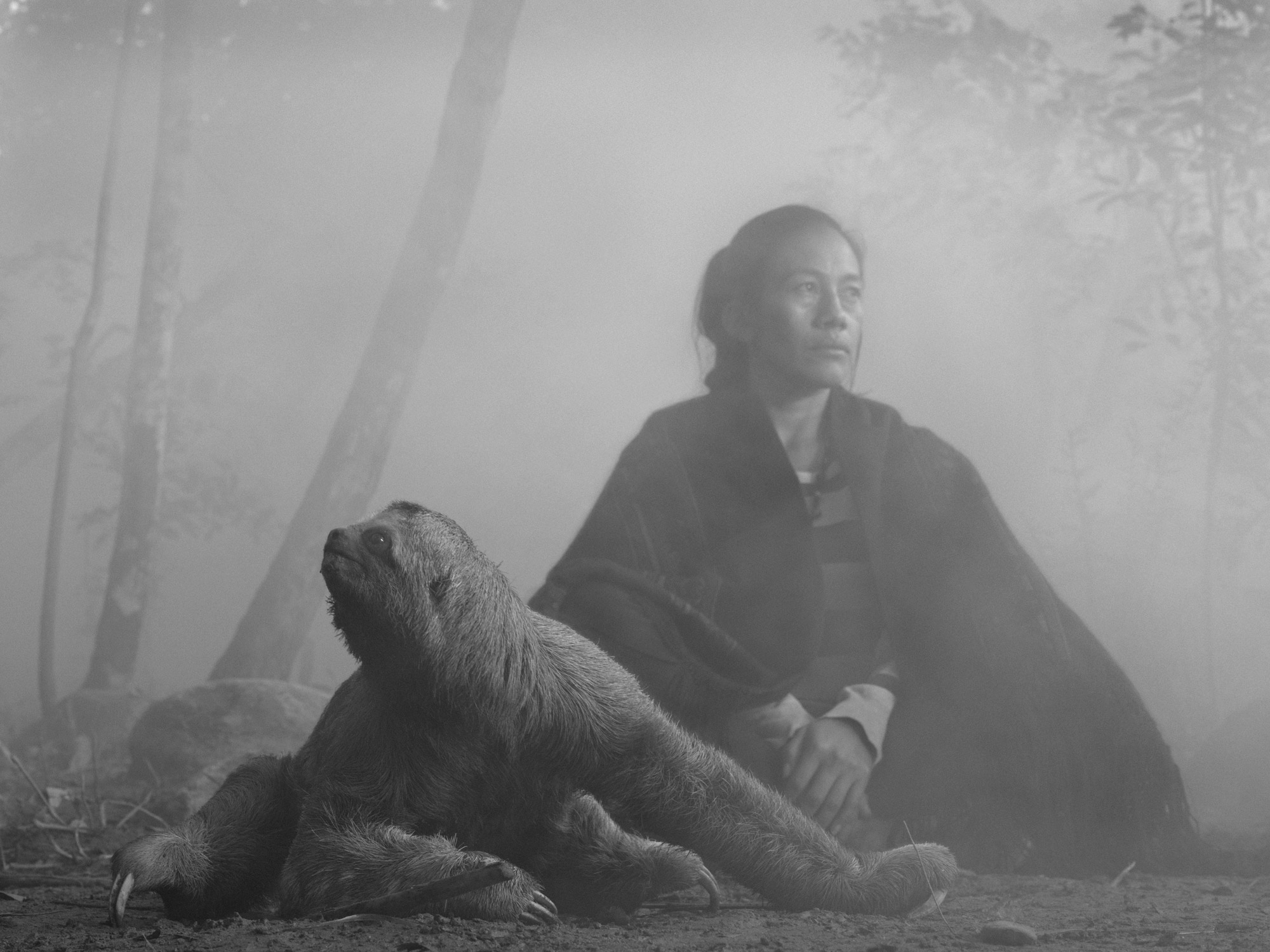
Ruth and Rosa, Bolivia 2022, by Nick Brandt, Courtesy of Willas Contemporary
MPB: The people featured in The Day May Break have been directly impacted by environmental degradation and destruction. Which story affected you the most?
NB: The truly emotional part was actually after the shoots when we interviewed everyone on camera and asked them if they would tell us their stories. I didn’t know if I would ever use these stories in video form, but I wanted to have them in case. It was during the telling of these stories that we heard so many heartbreaking stories. Many of the people were clearly still traumatized and broke down in tears.

Alice, Stanley and Najin, Kenya 2020 by Nick Brandt, Courtesy of Willas Contemporary
Kuda, from Zimbabwe, speaking in Shona, her native language, described through raging tears how she had seen her children swept away in floods, never to be found. But then towards the end, Kuda switched to English, and said, “but don’t worry about me. I am okay now. My life is like a newly-ripened banana”, by which I think she meant that she was ready to live life again, to take in experiences again. This is a woman who lost everything, was now in a camp for displaced refugees, and had the strength and will to be ready to move forward.
On a positive note, one collector of this photograph donated enough to help Kuda build part of her new home. In addition, a percentage of print sale proceeds is equally distributed among all the people in the photos.
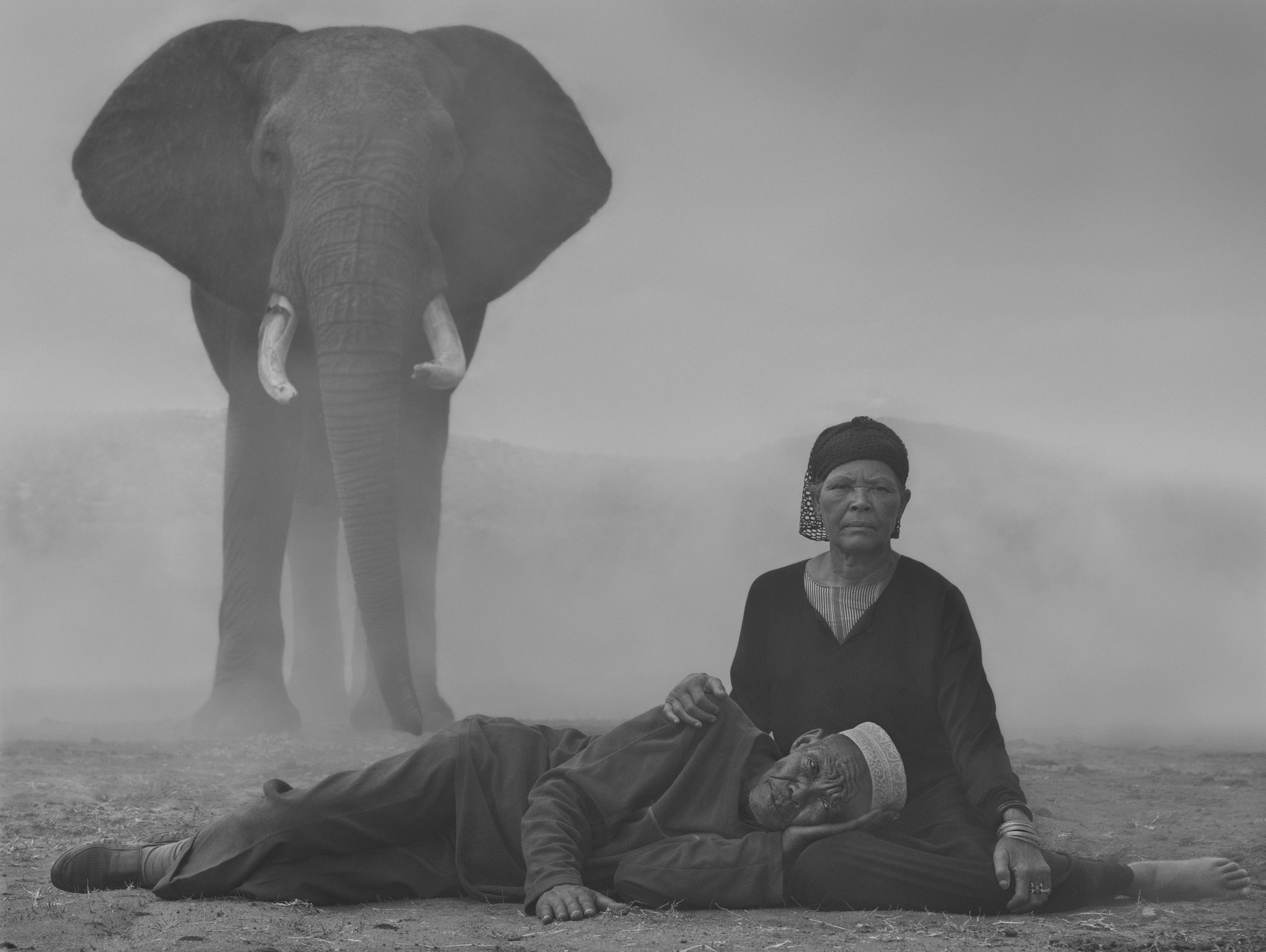
Fatuma, Ali and Bupa, Kenya 2020, by Nick Brandt, Courtesy of Willas Contemporary
MPB: What equipment did you use to shoot The Day May Break?
NB: The Day May Break was photographed with a Fujifilm GFX 100. I like it most of all for the tilt adapter for the eyepiece, which allows me to use the camera as a medium-format film camera as I used for many years, looking down into the equivalent of the ground glass. But its quick swivel enables me to switch from portrait to landscape in a second. Practically speaking, I need digital for this project because the fog was constantly shifting. So I needed to look back at the end of each session to see if it was hanging in the air at the moment the subjects seemed well-aligned within the frame. There was no post-compositing of any kind.
Harriet and people in a fog, Zimbabwe 2020 by Nick Brandt, Courtesy of Willas Contemporary
MPB: Do you believe there is hope for the future?
NB: Cue a big long weary sigh from my end. It’s complicated, isn’t it? However: I would not be taking these photos if I didn’t believe there was hope. I would not have co-founded Big Life, an incredibly effective Foundation in East Africa protecting 1.6 million acres of the ecosystem, if I did not believe there was hope. But it’s a kind of environmental ‘Sophie’s choice’ at this point. We know that we cannot save everything and that much will be lost. But that should not for one second stop us from doing everything we can to mitigate the damage.
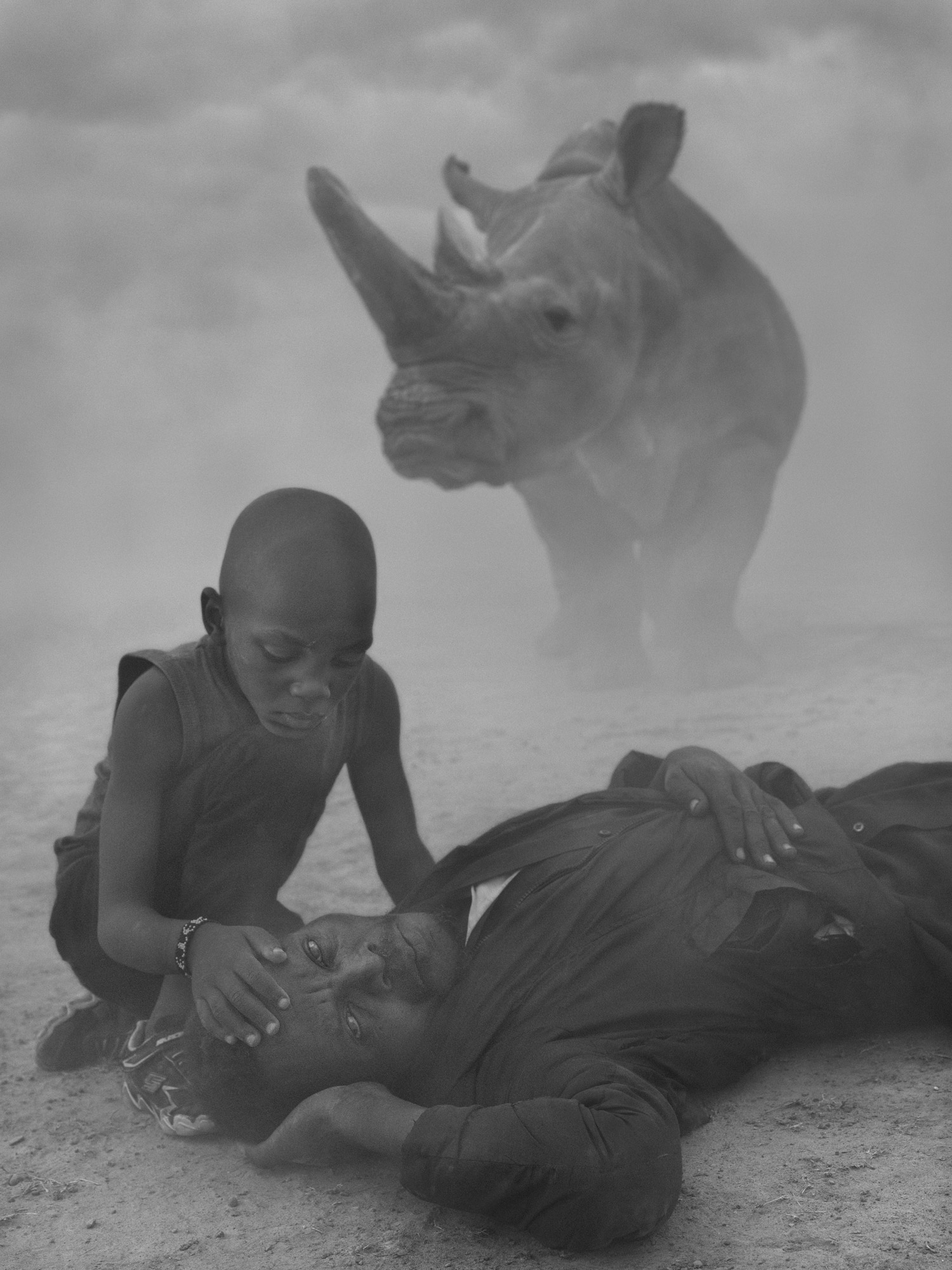
James, Peter and Najin, Kenya 2020, by Nick Brandt, Courtesy of Willas Contemporary
I come back to the phrase I use endlessly: It is better to be angry and active than angry and passive. Once you become active, the despair feels less overwhelming. Your actions—no matter how small—can energize and focus you. Those of us who care must continue to do our damnedest to try and preserve what we can, to minimize the damage as best we can. To keep on fighting for what we hold to be of indescribable value, poetry and beauty for both us, and those that come after us.
You can see more of Nick’s work on Instagram @nickbrandtphotography
Read more inspiring interviews on the MPB Content Hub.
You can sell or trade your camera gear to MPB. Get a free instant quote, free insured shipping to MPB, and get paid within days.