
At MPB, we fiercely believe that camera gear in human hands create true visual storytelling that AI will never be able to replicate. An authentic photograph is captured with skill, judgement and instinct which is why we’re passionate about protecting the craft of real photography. This belief is exactly why MPB exists: to make this expressive pathway to creativity more affordable and accessible to everyone.
To get a sense of where photography stands in the age of AI, MPB analysed employment, industry growth, job vacancies, and search demand across 10 European markets, alongside the prevalence and use of AI-generated imagery, to identify where opportunities for photographers are strongest and which specialisms show the greatest resilience.
Photography career opportunities across Europe
To understand the current landscape for photographers, we compared 10 European markets across four measures: four-year photography industry growth, live photography vacancies per capita, search demand for photography services and current photography industry employment per capita. These factors were then weighted equally to provide a score out of 100 to determine the market with the most opportunity for current and future photographers.
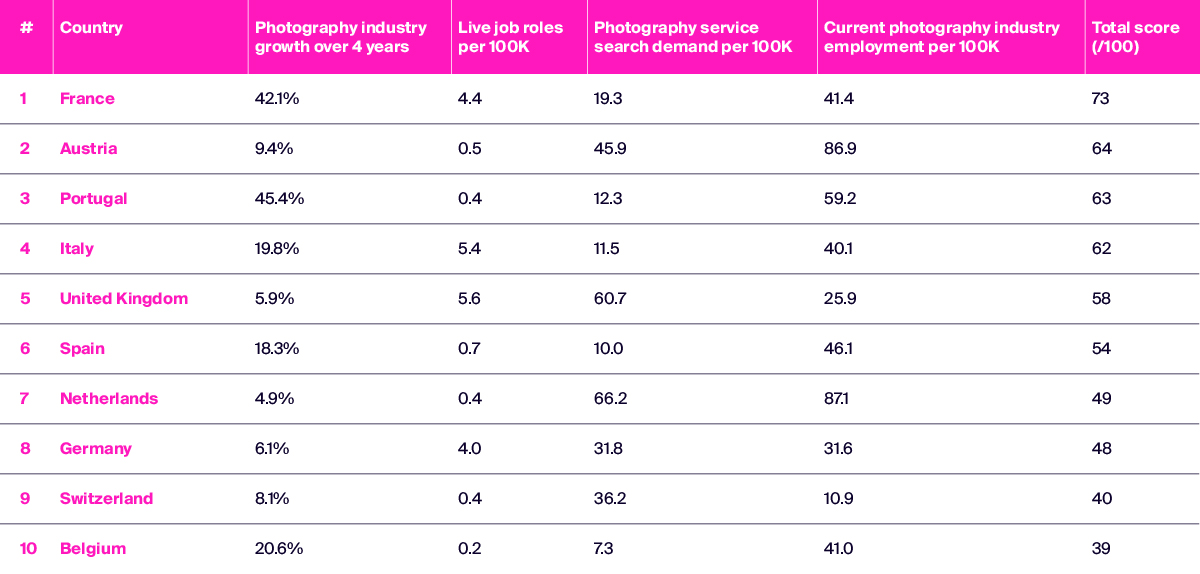
France comes out on top overall with a score of 73/100, nine points ahead of Austria. What stands out is that it performs well across several measures at once. Its photography industry has grown by 42.1% over four years, the second-fastest rate in the study, while it also has the third-highest concentration of live photography roles at 4.4 per 100,000 people.
The contrast with other markets helps explain why France ranks first overall; Portugal, for example, has seen the fastest industry growth overall at 45.4%, but has far fewer live roles. The UK tells a different story again, leading for current vacancies at 5.6 roles per 100,000 people, closely followed by Italy at 5.4.
There are also markets where the picture is more about an established photography industry than rapid growth. The Netherlands has the highest search demand for photography services at 66.2 searches per 100,000 people, as well as the largest photography workforce at 87.1 people per 100,000. Austria follows a similar pattern, with 86.9 photography workers per 100,000 people and strong search demand, which helps explain its second-place overall ranking.
Top 5 countries most interested in photography careers
To understand where people are most actively exploring photography as a career, we analysed monthly Google search demand for seven career-related terms.
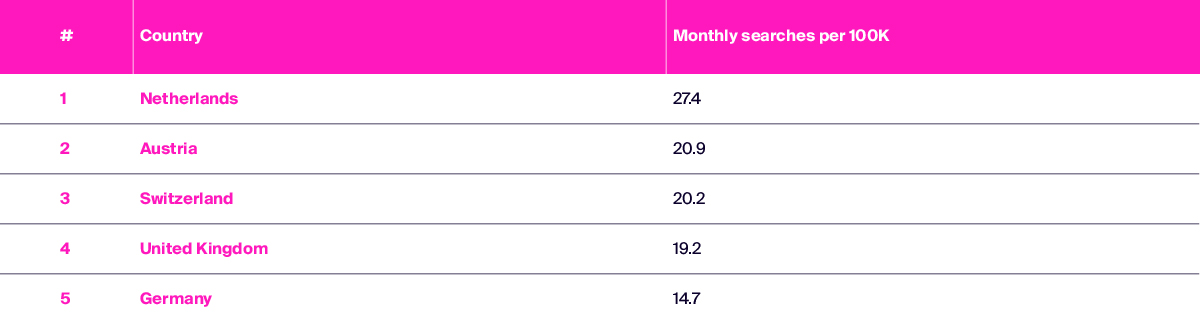
The Netherlands has the highest career-related search interest per capita at 27.4 searches per 100,000 people, followed by Austria at 20.9, Switzerland at 20.2 and the UK at 19.2.
The searches also reveal different areas of interest: “photography jobs” leads in the UK and France, while “photography courses” dominates in Germany and “photography apprenticeship” is particularly prominent in the Netherlands.
Europe’s most in-demand photography careers
To understand which photography specialisms currently have the strongest hiring demand, we analysed hundreds of thousands of live photography job adverts across the European markets in the study and grouped them by career type. We then calculated the share of total live vacancies represented by each specialism.
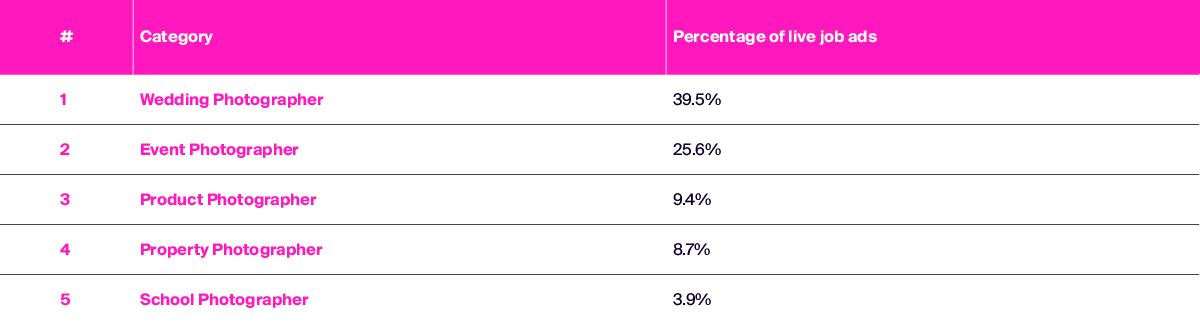
Weddings and events lead photography jobs
Wedding Photography is the most in-demand specialism in the dataset, accounting for 39.4% of live job ads analysed. Event Photography follows at 25.6%.
Together, these two categories make up 65% of all live photography vacancies analysed, showing how concentrated current hiring is around work that requires photographers to capture real people, places and moments.
How photography career demand differs across Europe
The research shows that career opportunity per photography niche varies greatly across countries.
Where in France, Wedding Photography leads the career pool, accounting for over 70% of the live roles, making it by far the most prominent specialism. Product Photography follows at a distant second, representing just 7.4% of opportunities. However, its neighbours, Italy and Germany, tell a different story.
Italy is similarly concentrated, but across two categories. Event Photography represents 47.6% of vacancies and Wedding Photography 46.4%, meaning the two together account for 94% of the Italian roles analysed.
Germany shows a very different pattern. Product Photography makes up 55.6% of live vacancies, while E-commerce Photography accounts for a further 22.2%. Combined, these two commercial specialisms represent 77.8% of the German roles analysed.
The UK has a much more varied vacancy mix than France, Italy or Germany. Product Photography leads at 21.2%, closely followed by Property Photography at 20.9%. School Photography accounts for 15%, Event Photography 13% and Fashion Photography 7.1%.
In Spain, Event Photography is the largest category at 37.3% of the roles analysed. Product, Fashion and Interior Photography each account for an additional 10.5%, giving Spain a more mixed jobs market in this dataset than France or Italy.
Photography careers most resilient to AI
AI is unlikely to affect every photography career in the same way. Some specialisms are centred on creating visual content that could, in part, be replicated synthetically, while others depend on being there to capture a real person, place or moment.
For that reason, we focused the AI resilience analysis on careers where generated imagery could realistically replace some of the finished visual output. Roles such as Wedding, Event, School, Sports, Editorial, Medical and Scientific Photography were left out because their value lies in documenting something that actually happened, which AI cannot replace like-for-like.
To compare those careers, we looked at three sides of the picture: how much live job demand there is for photographers, how common AI-generated imagery has already become on Adobe Stock, and how that imagery performs on Pixabay compared with how often it appears.
Bringing those measures together gives a clearer view of which photography specialisms are still showing strong real-world demand, while facing less pressure from synthetic imagery.
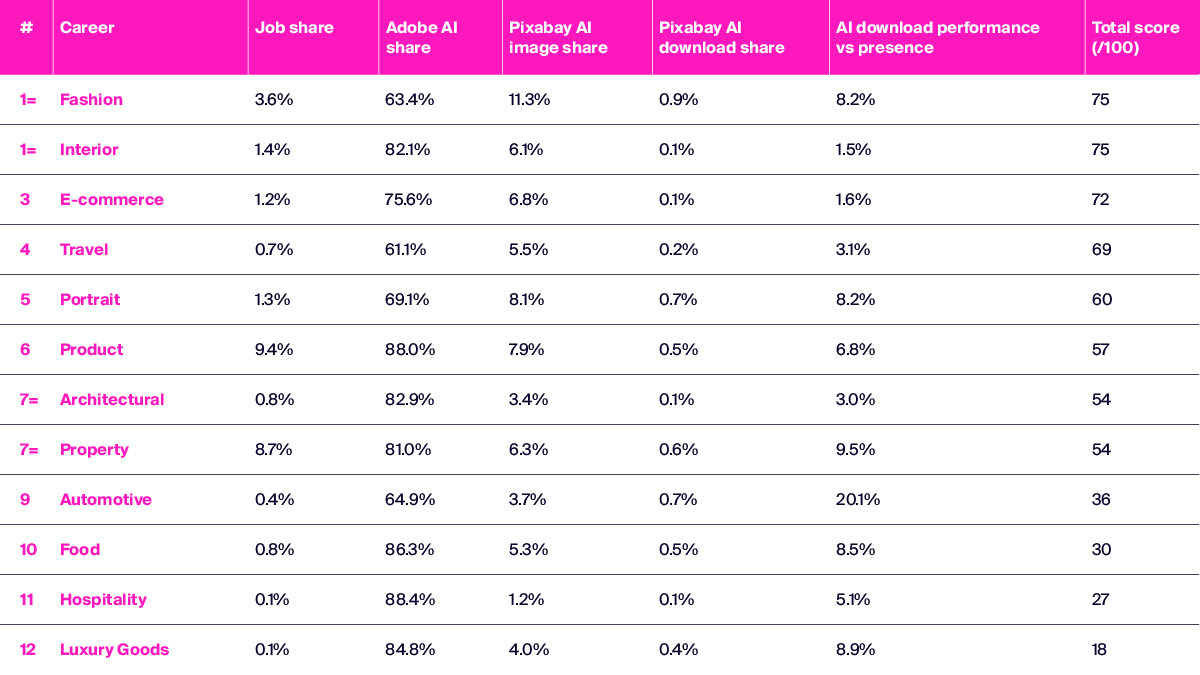
Where AI imagery is most established
Our data found that synthetic imagery has entered some areas of photography much more heavily than others. On Adobe Stock, Hospitality has the highest share of AI-generated imagery at 88.4%, followed by Product at 88% and Food at 86.3%. By comparison, Travel has the lowest AI presence of the 12 careers analysed at 61.1%, followed by Fashion at 63.4%.
Dr. Denise Maxwell, photographer and educator at Lensi Photography shares:
“AI is hugely impacting the creative industry. Every conversation I hear from large businesses surrounding AI focuses only on the benefits, which are usually grounded in making things faster. However, that process also means that people within this ecosystem lose their jobs. I have already had conversations with many creatives including graphic designers, editors, producers, stylists and make-up artists, whose income has been greatly affected.
Whilst championing and empowering photographers is great, it is not enough. There needs to be more conversations about the harm being caused to our profession by AI, and these voices need to be amplified. At the moment the one-sided perspective through rose-tinted glasses is not what I hear photographers say on the ground, but it is all that I hear employees saying on stages.”
AI availability vs audience demand
To understand whether the availability of AI imagery is translating into use, we also analysed up to 500 popular Pixabay results for each category. We compared AI’s share of the imagery with its share of downloads, allowing us to see whether AI images were attracting the level of downloads their presence might suggest. Across the careers analysed, AI imagery accounted for a much smaller share of downloads than its share of images.
Interior Photography provides one of the clearest examples: AI made up 6.1% of the imagery analysed but only 0.1% of downloads. E-commerce showed a similar pattern, with 6.8% AI imagery compared with just 0.1% of downloads.
Even in Automotive Photography, where AI performed strongest relative to its presence, AI accounted for 3.7% of imagery and 0.7% of downloads.
The findings show that simply making more synthetic imagery available does not mean it receives an equivalent share of use.
AI has less impact on Fashion and Interior
When demand for photography jobs is considered alongside AI presence and download behaviour, Fashion and Interior Photography rank joint first with scores of 75/100, followed by E-commerce at 72 and Travel at 69. They reach the top in different ways. Fashion combines comparatively strong employment demand with one of the lower levels of AI imagery on Adobe Stock. Interior has a much higher level of AI availability, but that doesn’t seem to be reflected in downloads.
This reinforces why the role of the photographer cannot be understood simply by looking at how much AI imagery exists. Demand for professional photographers continues even in categories where synthetic imagery is already widely available.
Product Photography shows why job demand still matters
Product Photography has the highest share of live vacancies among the 12 careers analysed, at 9.4%, despite also having the second-highest AI presence on Adobe Stock at 88%.
On Pixabay, AI represents 7.9% of Product Photography imagery analysed but accounts for only 0.5% of downloads.
Product Photography therefore ranks sixth overall at 57/100, but its strong employment figures demonstrate that a growing supply of generated imagery and demand for professional photographers can exist at the same time. For photographers, the data points to an industry that is changing, rather than one where the need for real photography has simply disappeared.
What real photography captures that AI can’t
AI-generated imagery can create a convincing simulation of a location, however, that’s all that it is, a limited and basic replica of a moment that never happened. AI images cannot capture the human creativity of photography; the imagination and soul behind a real moment. A photograph records a real memory through the judgement and instinct of the person behind the camera.
That difference comes through in the images below. The AI versions present polished, idealised interpretations of some of Europe’s best-known landmarks. The real photographs are less perfect: skies are grey, colours are more muted, people move through the background, and everyday moments unfold around the landmarks. But those imperfections are exactly what make them photographs; they show something that actually happened.
Take a look at the comparison below. Can you tell which image was photographed and which is AI generated?
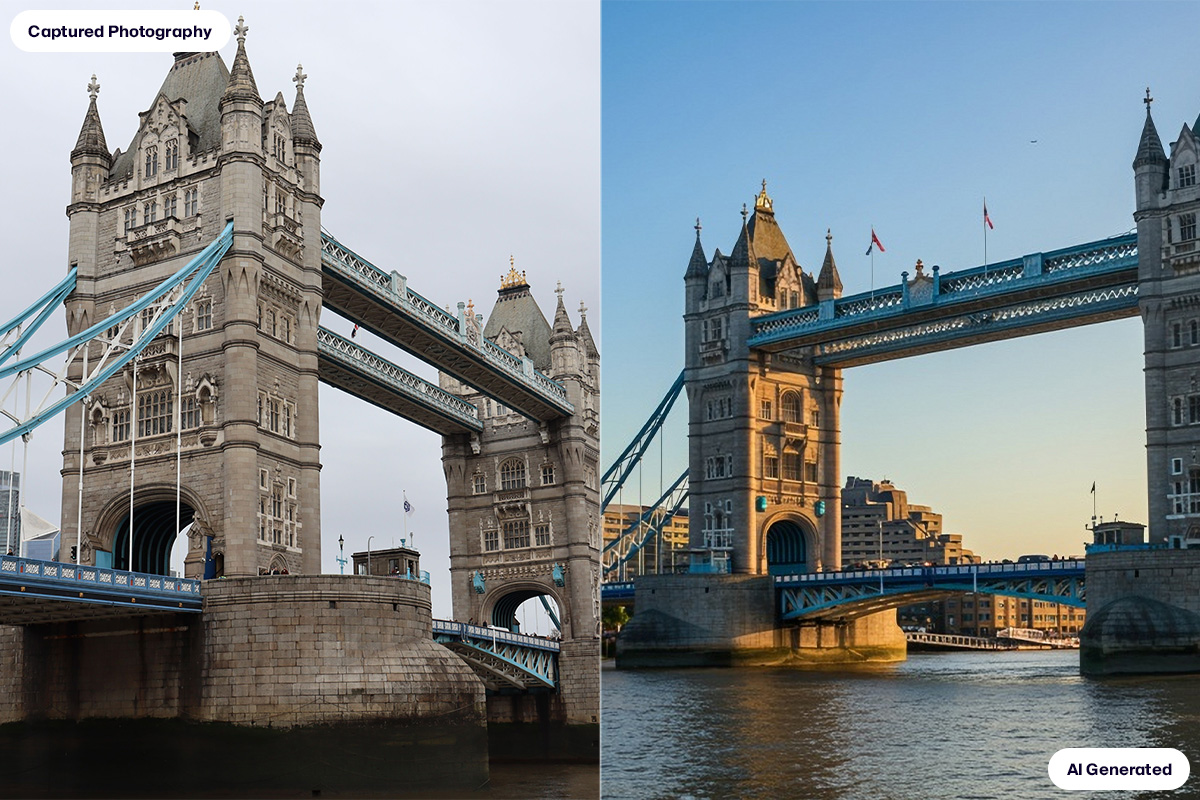
Left: Liam Broder | Right: Shutterstock AI
Photography still has a vital role in the age of AI
AI-generated imagery is becoming more visible across the photography landscape, but the data shows that its impact is far from uniform. In many specialisms, there is still clear demand for professional photographers, and the presence of synthetic imagery does not automatically translate into equivalent levels of use.
For photographers, that is an important distinction. Photography is not only about producing an image that looks convincing. It is about capturing real people, real places, real products and real moments, with the judgement, skill and perspective of the person behind the camera.
Sophie Collins, CMO at MPB shares:
"A photograph or a piece of footage that actually happened still carries something no AI image can fake, proof that someone was there to see it. That’s the thing worth protecting, and we protect it by giving photographers and videographers real choice, not by picking a side in the AI debate.
“A huge range of trusted, tested kit, at prices that mean quality gear isn’t reserved for whoever can afford it new. Real moments deserve someone who was actually there to capture them, and our job is making sure as many people as possible get that chance, with the choice, the price and the trust in their kit to go and do it properly.”
As tools and technology continue to evolve, the role of the photographer will evolve too. But the findings suggest that authentic photography, and the people who create it, continue to hold real value across the industry.
At MPB we are staunch defenders of the creative arts and believe that photographers and videographers should be championed in an ever-increasing AI world. Whether you're looking to buy used camera gear, or sell or trade camera equipment you no longer use, we're here to help photographers keep creating, experimenting and developing their craft.
Methodology and Sources
To understand where photography career opportunities are strongest and how different specialisms are currently being affected by AI-generated imagery, MPB analysed 10 European markets: Austria, Belgium, France, Germany, Italy, the Netherlands, Portugal, Spain, Switzerland and the United Kingdom.
For the country photography opportunity index, each market was compared using four measures. Photography industry growth and current industry employment were sourced from Eurostat for European markets and Nomis for the UK. Population data came from Worldometer, while live photography vacancies were sourced from Adzuna. Search demand for photography services was taken from Keywordtool.io and calculated per 100,000 people to allow markets of different sizes to be compared more fairly.
To measure interest in photography as a career, we used Keywordtool.io to analyse monthly Google search demand for seven career-related terms: how to become a photographer, photography apprenticeship, photography careers, photography courses, photography degree, photography jobs and photography salary. These volumes were also calculated per 100,000 people using population data from Worldometer.
For career demand, live photography job adverts sourced from Adzuna were categorised by photography specialism. We calculated each career's share of the total vacancies analysed and also compared the mix of roles within individual countries.
For the AI analysis, we focused on 12 careers where generated imagery could realistically substitute for some of the finished photographic output. Wedding, Event, School, Sports, Editorial, Medical and Scientific Photography were excluded because their core purpose involves documenting a specific real person, subject, event or situation.
AI resilience was assessed using three areas:
Current job demand, using live vacancy data from Adzuna
AI presence on Adobe Stock, calculated as the proportion of imagery returned for each photography category that was identified as AI-generated
AI download behaviour on Pixabay, based on up to 500 popular results for each category
For the Pixabay analysis, we compared AI's share of eligible imagery with its share of recorded downloads. To account for categories where a higher volume of AI imagery naturally creates more opportunities for AI images to be downloaded, we calculated AI download performance vs presence as:
AI share of downloads ÷ AI share of images × 100
A lower figure means AI imagery received a smaller proportion of downloads relative to how much of it appeared within the sample.
These measures were combined into the final AI resilience score out of 100. Higher scores indicate a stronger current combination of photography job demand and resilience to synthetic-image competition. The index is intended as a snapshot of the current market, rather than a prediction that any photography career is “AI-proof”.
For Pixabay, results were ordered using the platform's “popular” ranking and downloads represent cumulative recorded downloads rather than downloads during a fixed period. AI classification was based on Pixabay's own isAiGenerated metadata. Third-party sponsored imagery shown on the Pixabay website was not included in the API data analysed.